
Do You Need Planning Permission to Build a Garden Office?
One of the first tasks when buying a garden office is to ascertain if you need to apply for Planning Permission. It's not enough to rely on suppliers' websites that say "planning permission not required" because whether you need Planning Permission or not depends on where you live, what you plan to build, and what you are using the building for.
In many cases, a garden office can be built under ‘Permitted Development’ rules. These rules state the sizes and positioning of different-shaped buildings that can be built without the need for full Planning Permission, and they are clearly laid out on the Planning Portal website.
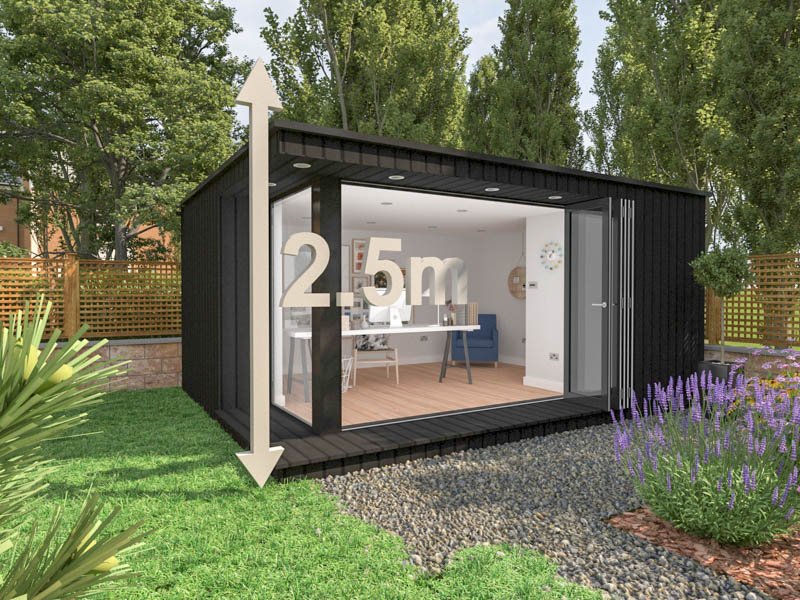
Permitted Development is a set of rules that tell you where you can build a garden office without a full planning application.
Make checking this one of your first tasks
We can’t stress how important it is to check whether you will need to apply for Planning Permission before you go too far down the buying process. In the worst-case scenario, you could be made to take down an unauthorised building—no one wants that!
If you are unsure if you need to apply for Planning Permission after reading the guidelines, it is worth applying to your local Planning Department for pre-planning advice. This is an informal application that allows you to ascertain whether planning is needed in your individual circumstances—you’ll have the advice one way or another in writing! Whether there is a fee and how much it is depends on your local authority. It is also worth applying for a Householder Lawful Development Certificate—this is not the same as applying for Planning Permission, but it is proof that your building work is lawful, which is useful when you come to sell the house.
Check if Permitted Development Applies to Your House
It is crucial to check if Permitted Development rules apply to your house before starting your garden office project. These rules allow you to build certain structures without the need for full Planning Permission, but they do not apply to all properties.
Firstly, if you live in a flat or a maisonette, Permitted Development rights do not apply. This means you will need to apply for full Planning Permission to build a garden office.
For houses, Permitted Development rights can be restricted or removed entirely in specific areas or types of properties:
- Listed Buildings: If your home is a Listed Building, you will not be able to build a garden office under Permitted Development. Listed Building Consent will be required for any alterations.
- Conservation Areas: Properties located in Conservation Areas have additional restrictions. You may be able to build a garden office, but the size and location will be more tightly controlled. Always check with your local Planning Authority.
- Areas of Outstanding Natural Beauty (AONB), National Parks, and the Norfolk or Suffolk Broads: In these designated areas, Permitted Development rights are more limited. You might still be able to build a garden office, but the rules are stricter regarding the size, height, and location of your building.
- World Heritage Sites: If your property is within a World Heritage Site, similar restrictions to those in Conservation Areas and AONBs apply. You will need to consult with your local Planning Authority.
Will Your Office Be Incidental to the Use of Your House?
If you look at the Planning Portal page for outbuildings, you will have see that Class E (a) says:
“(a) any building or enclosure, swimming or other pool required for a purpose incidental to the enjoyment of the dwellinghouse as such, or the maintenance, improvement or other alteration of such a building or enclosure;”
As this is a guide to garden offices, the word "incidental" in this clause is very significant.
We know from our years of experience that garden offices host a wide spectrum of different occupations. From lone workers to medical clinics, not all of these endeavours can be classed as incidental to the enjoyment of the home dwelling.
Whilst you working alone on your computer in an office may be considered an incidental use, a hairdresser using a garden office as a salon with a stream of clients probably wouldn’t be classed as incidental because it would have an effect on the neighbourhood, i.e. the number of cars, noise from visitors, etc.
Ascertaining if you need Planning Permission for your intended usage is another benefit of a Pre-Planning Advice Application.
Talk to Your Neighbours
If you do apply for Planning Permission, your neighbours will be asked their opinion about the building. It is good practice to talk to them and show them what you plan to build before they are contacted. In our experience, if a neighbour is aware of what is going to be built, how it will affect their view, how long it will take to build, and what you plan to use it for, it can avoid any problems during the application process.
Even if you are building under Permitted Development rules and therefore not applying for full Planning Permission, it’s still good practice to talk it through with your neighbours before you start work—an informed neighbour is a happy neighbour!
Don’t Be Fearful of Planning Permission
We know that many people are put off the idea of a garden office if they need to apply for Planning Permission. There is no real need to be fearful; many garden office suppliers report a 95% success rate with planning applications.
Actually applying for Planning Permission is quite straightforward and you can easily handle the application yourself, although many suppliers will handle it as part of the service they offer you. Whether there is a charge will depend on the supplier's policy. If your garden office supplier does not handle the planning application, you can engage a planning consultant. There are a number of firms that specialise in garden office planning applications. They are:
If you are handling the applications yourself, you should expect your supplier to provide you with scale drawings for submission with your application. You will also need a scale site map of your plot, on which you have to mark the proposed development—you can buy them via the Planning Portal.
The application will ask you about the external materials being used and how you will control rainwater. Again, you should expect your supplier to provide you with all the details, normally free of charge.
There is a fee for full Planning Permission. The 2024 fees are laid out in this Planning Portal document.
The Planning Permission application process takes around twelve weeks. Many companies will reserve you a slot in their order book so that once your application has been approved, work can start swiftly.
Do You Need to Consider Building Regulations
Whilst Planning Permission is at the forefront of a garden office buyer's mind, you also need to consider whether your build needs to comply with Building Regulations.
Building Regulations ensure that a building is built to the highest standards and is safe for occupation, particularly in relation to the spread of fire, and energy efficiency.
The Planning Portal says:
“If you want to put up small detached buildings such as a garden shed or summerhouse in your garden, building regulations will not normally apply if the floor area of the building is less than 15 square metres and contains no sleeping accommodation.
If the floor area of the building is between 15 square metres and 30 square metres, you will not normally be required to apply for building regulations approval, providing that the building contains no sleeping accommodation and is either at least one metre from any boundary or it is constructed substantially of non-combustible materials.”
If you are planning to site your building within one metre of any boundary and it is larger than 15 square metres, you also need to consider Building Regulations. Offices this close to the boundary need to be substantially built from non-combustible materials. In a multi-layer build-up, as typically used in garden office design, this means choosing a cement-based external cladding and using fire-proof plasterboard internally, amongst other measures.
As garden office designs become more elaborate, including kitchens and shower rooms, it is important that these elements are installed to Building Regulation